India-Based Data Entry Outsourcing Support Serving USA, Canada, UK, Australia, Europe, New Zealand, Singapore, UAE
Logistics Data Entry

Logistics Data Entry Services Aligned With Shipment Milestones, Document Cut-Offs and Exception Ownership

A logistics date may describe booking, departure, arrival or delivery; a reference may identify a shipment, container, seal or invoice. Our professional entry workflow preserves those distinctions so an update follows the correct movement.

Bills of lading, manifests, carrier reports and proof-of-delivery images enter an offshore queue organised around shipment identifiers and operational cut-offs. Conflicting references are held instead of attached to the nearest-looking record.

Freight teams outsource routine capture without transferring authority to release cargo, approve charges or change commitments. The expert solution connects evidence, system permissions and reason-coded exceptions to the responsible dispatch, customs or billing owner.

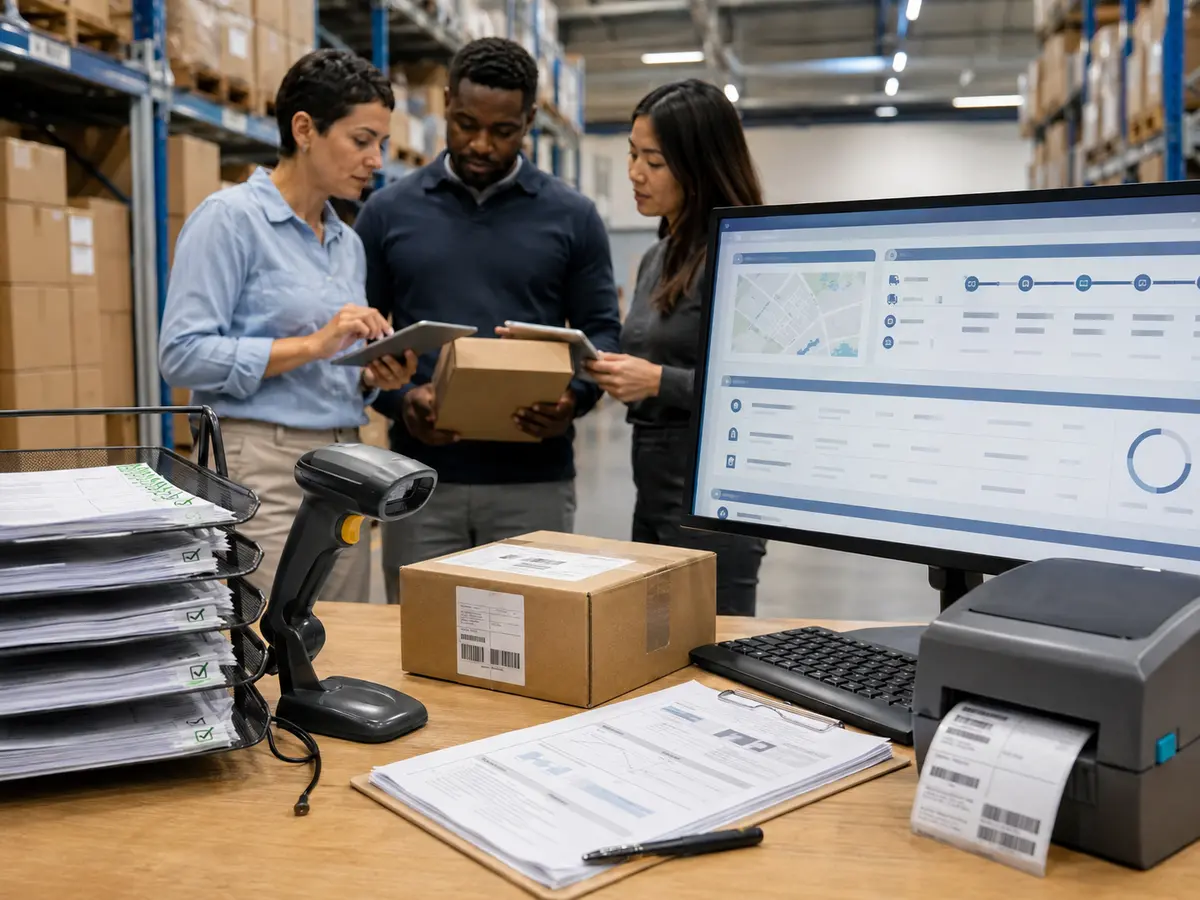
Shri Data Entry Services team working on Logistics Data Entry Services projects
5000+ Completed Projects
90% Returning Clients
16+ Years Experience
45+ Countries Served
50+ Professionals Team
Services We Offer

A logistics record must stay connected to the physical movement and its supporting documents

  • Shipment reference confirmed
  • Document type identified
  • Milestone evidence retained
  • Units and location codes standardised
  • Charges separated from approval
  • Late and unclear documents queued

A date on a logistics document may represent booking, departure, arrival, delivery or document issue. A number may be a shipment, container, seal, invoice or purchase-order reference. Field meaning must be defined before production.

We map each source to the transport or warehouse record it supports. If references conflict, the item is held rather than attached to the most similar shipment. This protects tracking, billing and customer communication.

Timing is part of quality. Daily operations may need morning and afternoon cut-offs, while archival freight files may use weekly batches. The service design reflects when the record must be available and who resolves exceptions.
Data support across freight, transport, warehouse and delivery administration

The client retains operational authority; SDES maintains the approved information flow.

01

Booking and shipment entry

Approved shipper, consignee, route, mode, weight, volume, service and reference fields are entered from booking sources into the required template or system.

02

Bill of lading data entry

Document numbers, parties, ports, container references and shipment details are captured without interpreting legal or customs obligations.

03

Proof-of-delivery processing

Delivery date, recipient, reference and visible status are indexed to the correct shipment; missing signatures or conflicting references are held.

04

Carrier and vendor records

Approved carrier, lane, service and contact information is maintained while commercial approval and banking changes remain internal.

05

Inventory and warehouse updates

Item, quantity, location and movement fields are entered from authorised documents using supplied unit and status rules.

06

Freight invoice support

Invoice headers, line items and shipment references are captured for finance review; rate disputes and payment approval are not decided by the entry team.

Document System Compatibility

Logistics Data Entry Services: Direct Integration and Software Compatibility

Outputs are prepared around the field structure, controlled values and import requirements of your destination environment. Files can be delivered for review, staging or authorised import without forcing your team to rebuild the completed work.

Supported destinations

DMS-compatible files and metadata for searchable repositories

Files are mapped to the client’s approved template, naming rules, identifiers and system structure before full production begins.

  • SharePointLibraries and metadata columns
  • OpenTextEnterprise content repositories
  • iManageLegal matter workspaces
  • NetDocumentsCloud document profiles
  • AlfrescoContent models and properties
  • Custom SQLStaging and relational tables
Source continuity

References stay connected

Source IDs, filenames, record keys and approved relationships remain available for review and downstream traceability.

Import control

Fields are mapped before production

Mandatory fields, formats, controlled values, character limits and relationship keys are checked against the destination specification.

Pilot validation

Test the handoff with a representative batch

Rejected rows, unsupported values and mapping conflicts are returned with exact references so approved corrections can be incorporated before full-volume delivery.

Delivery formatsStructured for review, staging or import
  • CSV
  • XLSX
  • XML

Column order, encoding, date rules, multi-value handling and destination-specific requirements can follow the receiving system’s approved specification.

Compatibility means SDES prepares outputs to specifications supplied or approved by the client. Product names identify commonly used destination systems and do not imply endorsement, certification or partnership.

Process, Quality and Security

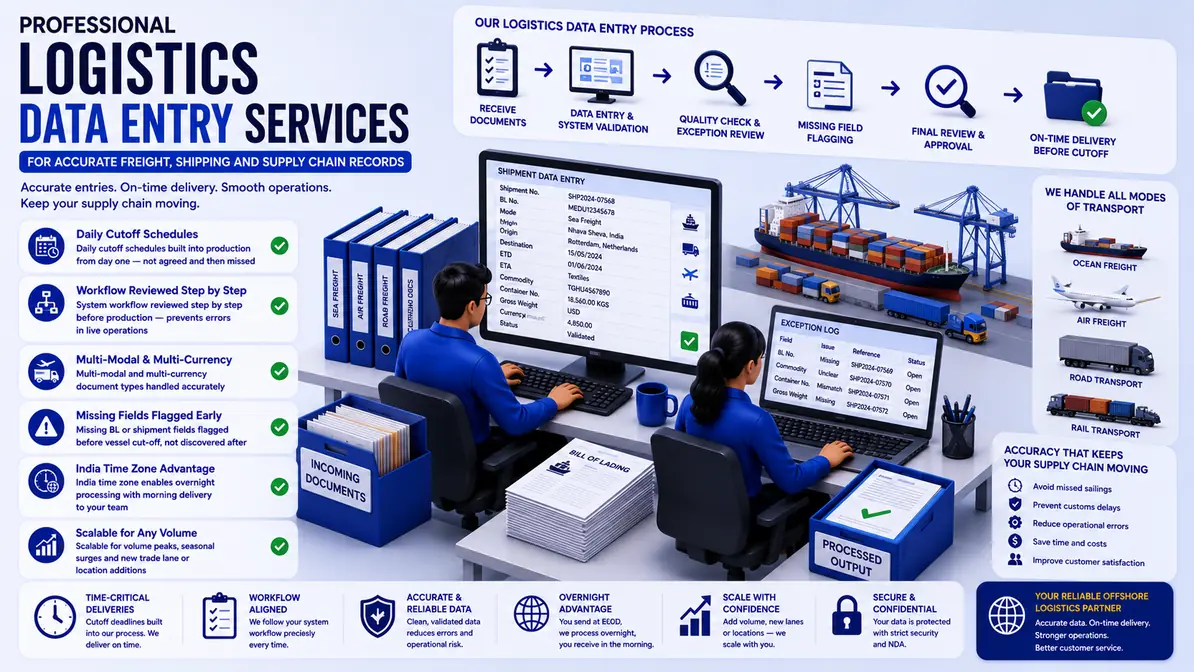
How logistics data is processed around operational cut-offs

1. Map Documents to Events

Each source is linked to the booking, movement, delivery or billing event it supports.

2. Confirm Identifiers and Codes

Shipment, container, location, carrier, unit and status formats are documented.

3. Set Cut-Offs and Ownership

Release times, priority rules and the people responsible for exceptions are agreed.

4. Test Normal and Disrupted Cases

The sample includes missing documents, changed routes, unclear PODs and duplicate references.

5. Capture and Cross-Check

Operators enter supported fields and review required relationships before release.

6. Deliver by Operational Queue

Completed updates, late sources and decision items are separated for the responsible team.

Every entered milestone should be supported by the right shipment evidence

📂 Source formats we accept
  • Bills of lading and airway bills
  • Booking sheets and manifests
  • POD images and delivery notes
  • Carrier and warehouse reports
  • TMS, WMS or ERP field rules
📤 Delivery formats
  • Shipment update files
  • POD indexes
  • Carrier and route tables
  • Freight invoice capture files
  • Operational exception queues
Free accuracy test

Which logistics event should the record support?

Share representative documents, system fields, cut-off times and exception ownership. We will map the production workflow around the real operation.

✓ No credit card required✓ No contract required✓ 24–48 hour return
Discuss the Logistics Workflow
Source sampleyour_sample_data.csv
Received
Verified deliveryverified_output.xlsx
Reviewed
▣ Encrypted transfer◉ Quality controlled
Why Outsource to SDES?

Why logistics teams outsource repeatable records but retain movement decisions

Logistics Data Entry Services workflow and quality review
  • Document-to-shipment mapping
  • Cut-off based production
  • Location and unit rules
  • Restricted system actions
  • Expert exceptions kept internal
  • Offshore capacity for peaks

A professional workflow reduces administrative pressure without allowing data entry to become an uncontrolled operational action. Clients outsource routine capture while dispatch, customs and finance teams retain authority.

Our offshore team follows the approved evidence and status rules. Expert questions are raised through a defined exception queue instead of being buried in general delivery notes.

Start Your Project →
Industries We Support

Logistics records across different movement networks

Freight Forwarding

Booking, transport document and milestone data prepared around shipment references.

Manufacturing

Inbound materials, supplier deliveries and inventory movement records maintained.

Retail Fulfilment

Order, shipment, delivery and return-support records structured for operations.

Freight Audit

Invoice and shipment facts captured for authorised rate and payment review.

Warehousing

Location, receipt, dispatch and stock-movement fields entered from approved sources.

Transport Services

Carrier, route and customer records maintained under defined permissions.

Case Studies

Relevant Project Experience

Dual-Cut-Off POD Index

Project Name
Dual-Cut-Off POD Index
Volume
75,461 records — completed in 11 weeks
Problem
POD images arrived with inconsistent shipment references and had to support same-day customer service. For the Dual-Cut-Off POD Index in Australia workload, reviewers spent additional time opening individual files because filenames and folder locations did not answer common retrieval questions.
Solution
Reference matching, cut-off rules and a missing-signature queue were defined. For Dual-Cut-Off POD Index in Australia, each index row retained its source filename or document reference, and unclear classifications were separated for records-owner review.
Outcome
The model delivered searchable POD records without attaching uncertain images to the wrong shipment. As a result of the Dual-Cut-Off POD Index in Australia workflow, records personnel received both a searchable index and a smaller exception queue for incomplete or uncertain documents.
Title
Transport Systems Manager
Industry
Road Logistics
Country
Australia

Freight Invoice Reference Capture

Project Name
Freight Invoice Reference Capture
Volume
12,765 files per month
Problem
Finance reviewers spent time locating shipment, route and surcharge facts before validation. Within Freight Invoice Reference Capture in United States, the resulting uncertainty weakened segmentation and made routine follow-up more dependent on manual verification.
Solution
Objective fields were captured and linked to supplied shipment references; rate disputes stayed internal. For Freight Invoice Reference Capture in United States, confirmed identifiers controlled updates, while duplicate, ownership and relationship decisions remained with authorised CRM administrators.
Outcome
The proposed output gave finance an organised review file and mismatch queue. After completing Freight Invoice Reference Capture in United States, the archive became easier to migrate, audit and retrieve without losing the link to the original source files.
Title
Freight Audit Lead
Industry
Distribution
Country
United States

Inbound Material Register

Project Name
Inbound Material Register
Volume
21,223 records — completed in 10 weeks
Problem
Plants used different location and unit descriptions for the same items. During the Inbound Material Register in Germany review, without a controlled structure, the client could not separate records ready for use from those requiring an authorised decision.
Solution
Approved site and unit mappings were applied while unsupported conversions were held. During production for Inbound Material Register in Germany, priority identifiers and cross-field relationships were checked before the clean delivery file was released.
Outcome
The solution produced consistent records without allowing the offshore team to alter inventory policy. After completing Inbound Material Register in Germany, product, variant and asset relationships remained consistent across releases, reducing repeated correction work for merchandising teams.
Title
Supply Chain Data Manager
Industry
Manufacturing
Country
Germany
FAQs

Questions about logistics data entry

Can SDES update our TMS or WMS directly?

Potentially, through restricted accounts and approved actions. Release, routing, inventory and billing authority remains with the client.

How are documents with missing shipment references handled?

They are held with the available evidence and reason code rather than linked to a similar record by assumption.

Can the service follow daily operational cut-offs?

Yes, when arrival times, expected volume, priority rules and exception ownership are agreed during setup.

What should a Logistics Data Entry Services pilot contain?

Provide Bills of lading and airway bills, Booking sheets and manifests, POD images and delivery notes. The pilot should include ordinary records and known exceptions so field interpretation, review rules and delivery structure can be confirmed before production.

📩 Review a Logistics Batch
💬