India-Based Data Entry Outsourcing Support Serving USA, Canada, UK, Australia, Europe, New Zealand, Singapore, UAE
Document Management Services

Professional Document Management Services for Organised, Accessible and Maintainable Business Archives

We provide expert document management outsourcing solutions for businesses that need their physical or digital document collections organised, consistently named, classified and maintained so the right document can be found when it is needed. The hidden cost of poor document organisation is significant: time spent searching, documents resent because originals cannot be located, decisions delayed because supporting documentation is not accessible and compliance gaps created when required records cannot be produced for audit.

Our professional offshore document management team in India processes document collections of any size systematically — applying naming conventions, folder structures, classification taxonomies and metadata standards across the complete collection — and establishes ongoing management workflows that keep document organisation consistent as new files arrive over time.

Good document management solutions are not primarily about the technology platform you use. SharePoint, Google Drive, a network file server or a specialist ECM platform all work well when documents follow consistent naming, classification and structure standards. The work is in defining and applying those standards consistently across a collection that may already contain years of inconsistently organised files.

5000+ Completed Projects
90% Returning Clients
16+ Years Experience
45+ Countries Served
50+ Professionals Team
Services We Offer

Systematic document management solutions that make every file findable and every archive maintainable

  • Document collection review and quality assessment
  • Classification taxonomy design or application
  • File naming convention development and implementation
  • Folder hierarchy and archive structure design
  • Metadata and index field creation
  • Ongoing document management and maintenance cycles

Effective document management requires consistent application of defined naming and classification rules across every document in the collection — not just the ones added after the new system was implemented. Legacy collections that have accumulated years of inconsistently named and organised files require systematic reorganisation before the benefits of a document management system are fully realised.

We begin every document management project with a collection review: understanding the document types present, the current naming approach, the primary retrieval use cases and the systems the documents need to work with. From this review, we agree a practical classification structure and naming convention before any reorganisation work begins.

As a professional document management outsourcing partner in India, SDES provides the systematic effort required to reorganise large document archives and establish ongoing management workflows at a fraction of the cost of equivalent internal staff.

Document Management Services We Offer

We organise, structure, rename, classify and maintain business document collections so teams can find, control and use files without depending on scattered folders or inconsistent naming.

01

Folder structure and archive organisation

We organise scattered document collections into logical folder structures based on departments, clients, projects, dates, document types, vendors, cases or your own operating model. Many archives become difficult to use because files are saved wherever staff members found convenient at the time. We review the current folder condition, identify repeated patterns, propose a structure and then move or map files according to approved rules. This reduces search time and prevents different teams from maintaining competing versions of the same document set.

02

File naming convention development and application

We apply consistent file naming rules to PDFs, scans, images, Word documents, spreadsheets, contracts, invoices, HR files, customer records and project documents. A good naming convention makes files readable before they are opened and supports sorting by date, client, record type or reference number. We confirm the order of naming elements, approved abbreviations, date format, version labels and duplicate handling before renaming begins. Files that cannot be named confidently due to missing information are separated for review.

03

Document classification and metadata support

We classify documents and capture metadata such as document type, date, author, client, vendor, matter, department, account, status or retention category. This supports document management systems, shared drive cleanup, archive migrations and audit preparation. Classification is performed according to your taxonomy rather than the operator's opinion. Where the document type is ambiguous or the required metadata is not present, we flag the item instead of forcing inaccurate labels.

04

Duplicate, obsolete and version file review

We identify duplicate files, near-duplicates, obsolete versions, renamed copies, scanned duplicates and conflicting document versions. Duplicate review must be handled carefully because files can look similar while containing different signatures, revision histories, attachments or dates. We follow your decision rules for whether to keep, archive, mark or remove duplicates, and we provide review lists for files that need client approval before any final action.

05

Ongoing document management maintenance

We support recurring document management work such as weekly folder cleanup, new file classification, archive updates, DMS preparation, scan folder processing, document upload support and naming compliance checks. Once your rules are confirmed, the same team can maintain the archive on a regular schedule, helping prevent the folder chaos that usually builds up when document control is treated as a one-time cleanup project.

Process, Quality and Security

How we turn scattered files into a controlled document system

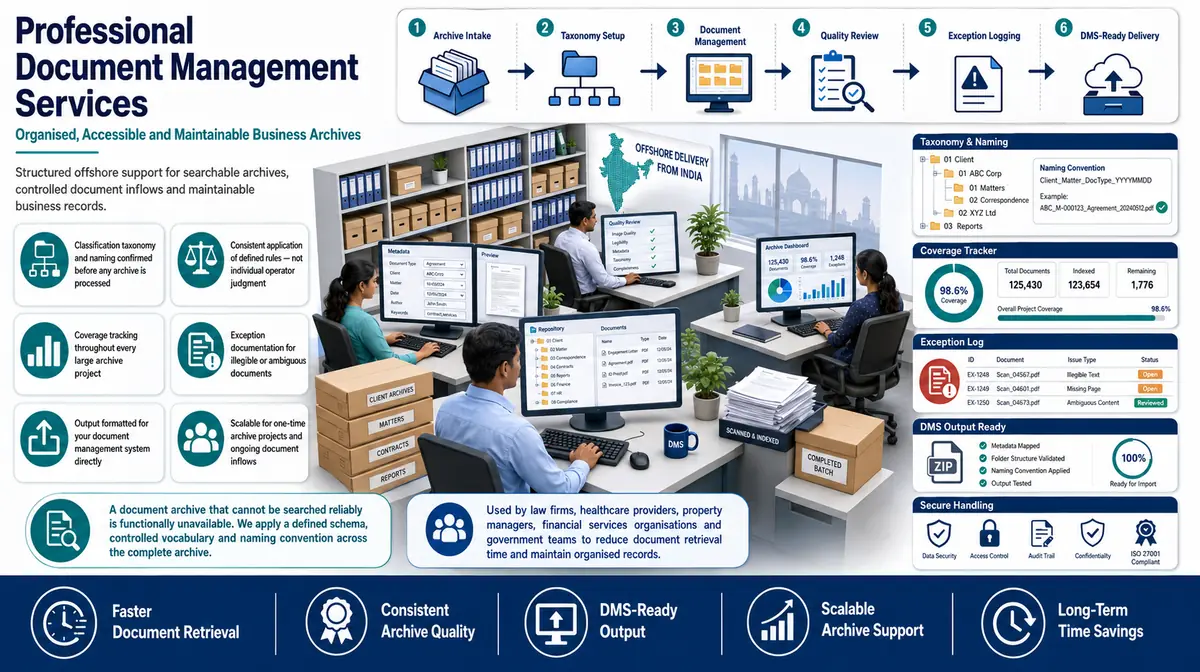
1. Archive condition review

We review folder samples, file types, naming problems, duplicate patterns, document categories and the way your team needs to search and use the files.

2. Rules and access setup

We confirm naming rules, folder structure, metadata fields, duplicate handling, permission limits and secure access before any file movement or renaming begins.

3. Pilot folder cleanup

A small folder or document set is organised first so you can approve the structure, file names, category labels and exception reporting format.

4. Full archive organisation

Documents are classified, renamed, moved, indexed or prepared for upload according to the approved rules, with progress tracked by batch.

5. Quality and duplicate review

We check folder placement, naming consistency, metadata completeness, duplicate lists, broken references and unresolved files before delivery.

6. Handover and maintenance plan

We deliver the organised files, index sheets or DMS-ready package with notes on exceptions and recommendations for keeping the archive clean going forward.

📂 Source formats we accept

  • Existing unorganised digital document collections
  • Scanned document batches requiring organisation
  • Network drive or cloud storage exports
  • Legacy filing system records
  • Mixed format document collections (PDF, Word, Excel, images)

📤 Delivery formats

  • Reorganised and renamed document collection
  • Classification taxonomy and naming convention documentation
  • Folder structure implementation in your platform
  • Metadata and index spreadsheets
  • Archive inventory and reorganisation report

Document management quality means the system remains usable after delivery. We design and apply naming, folder and metadata rules that match how your staff will search, sort, audit and maintain files.

Your business documents may include contracts, HR records, financial files, client documents, legal papers and internal reports. These are handled confidentially with controlled access and your approved transfer method.

We do not delete, merge or overwrite questionable files without instruction. Duplicates, obsolete versions, unclear categories and files missing required identifiers are listed separately so your team keeps control over final document decisions.

📁 Folder Cleanup Archive organised
📝 File Naming Rules applied
🏷️ Metadata Search fields
🔁 Duplicate Review Versions checked
🔐 Confidential Files Access controlled
📦 DMS Ready Upload support

Is your document archive making daily work slower than it should be?

Share a sample of your current document collection and describe your primary retrieval use cases. We recommend a practical organisation approach and provide a free pilot reorganisation sample so you can evaluate the approach before committing.

Discuss Your Project →

Initial consultation and pilot sample at no charge.

Why Outsource to SDES?

Why organisations outsource document processing and indexing to SDES India

Why outsource to SDES
  • Classification taxonomy and naming confirmed before any archive is processed
  • Consistent application of defined rules — not individual operator judgment
  • Coverage tracking throughout every large archive project
  • Exception documentation for illegible or ambiguous documents
  • Output formatted for your document management system directly
  • Scalable for one-time archive projects and ongoing document inflows

A document archive that cannot be searched reliably is functionally unavailable. The goal of every document processing project is an archive where the right document can be found quickly every time — not most of the time. That requires consistent application of a defined schema, controlled vocabulary and naming convention across the complete collection, not just the most recent additions.

We have processed document archives for law firms, healthcare providers, property managers, financial services organisations and government teams. In each case, the result was an archive that reduced the daily cost of document retrieval significantly — and continued to save time for years after the project completed.

Start Your Project →
Industries We Support

Professional document management solutions across information-intensive industries

eCommerce

eCommerce

Online retailers and marketplace sellers that need accurate product data, catalog management, marketplace listing support and order management data entry handled consistently at scale without burdening their internal team.

Healthcare

Healthcare

Medical practices, billing companies and healthcare providers that handle patient records, clinical data, insurance information and billing documentation requiring precise entry and confidential handling.

Real Estate

Real Estate

Property firms, real estate agencies and title companies managing listing details, transaction records, deed data and client databases across large and growing portfolios.

Finance

Finance

Accounting firms, finance departments and financial services companies processing invoices, statements, claims, reconciliation records and financial document data at recurring volume.

Legal

Legal

Law firms and legal departments digitising and managing case files, contracts, compliance records, court documents and legal correspondence with appropriate confidentiality controls.

Logistics

Logistics

Freight companies, 3PLs and supply chain teams maintaining accurate shipment records, supplier data, inventory counts and delivery documentation across high-volume operations.

Manufacturing

Manufacturing

Manufacturers needing product specifications, supplier records, quality inspection data and inventory management data entry for production and procurement systems.

Agencies

Agencies

Marketing agencies, digital agencies and business services firms outsourcing data entry, list building, research and campaign data management to a reliable offshore partner.

Client Feedback

What clients say about our document management work

★★★★★

We had 28,000 pages of scanned closed matter files with no metadata — just sequential TIFF numbers. SDES indexed the full collection with document type, matter reference, date and sequence. Indexing was consistent throughout. Our attorneys could search the historical archive by matter reference for the first time.

Evelyn S. — Litigation Support Manager Law Firm, USA
★★★★★

12 years of tenant files had been scanned but were completely unorganised — 6,200 documents. SDES classified, named and organised the full collection over eight business days. The naming convention was applied consistently and our property managers could navigate the archive reliably from day one.

Lucas D. — Operations Manager Property Management Company, Australia
★★★★★

The indexing project covered three offices over four months. SDES tracked coverage by office and document category with weekly progress reports. We knew exactly where we were throughout. Archive quality was consistent across all three locations despite variation in source materials.

Freya N. — Records Manager Financial Services Organisation, UK
FAQs

Questions clients ask before outsourcing document management to India

Can you work with our existing document management platform?

Yes. We work with SharePoint, Google Drive, network file systems, Dropbox Business, Box, M-Files and most other platforms. Platform-specific naming limitations or metadata requirements are incorporated into the agreed naming and classification approach.

How long does a large archive reorganisation project take?

A 10,000-document office archive reorganisation typically takes 2-4 weeks including inventory, structure design confirmation and phased reorganisation with review. We confirm a specific timeline after reviewing your document collection sample.

Can you help design the classification system or do we need to provide it?

Both options work. We can design a classification system based on your business structure and use cases, or implement a taxonomy you have already defined. A collaborative approach — where we review your collection and recommend a structure — often produces the most practical result.

What happens to documents that do not fit the classification?

Documents that do not fit clearly within the taxonomy are flagged in a review list with the classification question noted specifically. Your team makes the final decision on edge cases rather than having us impose an arbitrary classification.

Can you maintain ongoing document organisation for new files?

Yes. Ongoing management arrangements process new document inflows on weekly or monthly cycles with consistent classification and naming standards maintained throughout.

What if our collection contains sensitive or confidential documents?

All document management projects begin with a signed NDA. Sensitive documents are handled with the same access controls and transfer security applied to all SDES engagements. Specific sensitivity handling requirements are confirmed at project setup.

📩 Discuss Your Project
💬