
India-Based Data Entry Outsourcing Support Serving USA, Canada, UK, Australia, Europe, New Zealand, Singapore, UAE
Product Inventory Management Services

Product Inventory Management Support That Keeps Stock Records Traceable Across Locations and Channels

Inventory data becomes unreliable when receipts, sales, returns, transfers and adjustments reach systems on different schedules. A quantity may be numerically valid yet belong to the wrong SKU, warehouse, condition or timestamp. Our professional product inventory management services maintain those distinctions before stock data is updated.

An expert setup review defines the inventory owner, source systems, SKU-location keys, quantity types, cut-off times, adjustment reasons, channel rules and escalation thresholds. The delivery team then records and reconciles authorised events while physical counts, purchasing, allocation policy and final stock authority remain with the client.

Retailers, distributors and manufacturers outsource recurring inventory data work when internal teams need more time for planning, fulfilment and exception resolution. The solution provides timestamped updates, source-to-system reconciliation and a separate queue for negative balances, duplicate events and conflicting stock evidence.

Shri Data Entry Services team working on Product Inventory Management Services projects
5000+ Completed Projects
90% Returning Clients
16+ Years Experience
45+ Countries Served
50+ Professionals Team
Services We Offer

Keep on-hand, available, reserved, damaged and in-transit stock from becoming one misleading number

  • SKU identity confirmed
  • Location retained
  • Quantity type defined
  • Cut-off time recorded
  • Reason code required
  • Approval owner assigned

Physical on-hand inventory is not always the quantity available for sale. Reservations, safety stock, pending inspection, damaged goods and transfers can change availability without changing the count physically present at a location.

We map each source field to the approved inventory state and preserve the event date, location, reference and unit of measure. Updates that lack the evidence required by the client’s rule remain pending instead of being forced into the balance.

Structured delivery support handles repetitive transaction entry and channel-file preparation. The documented workflow gives planners and warehouse owners a consistent evidence trail while keeping operational and commercial decisions under their control.
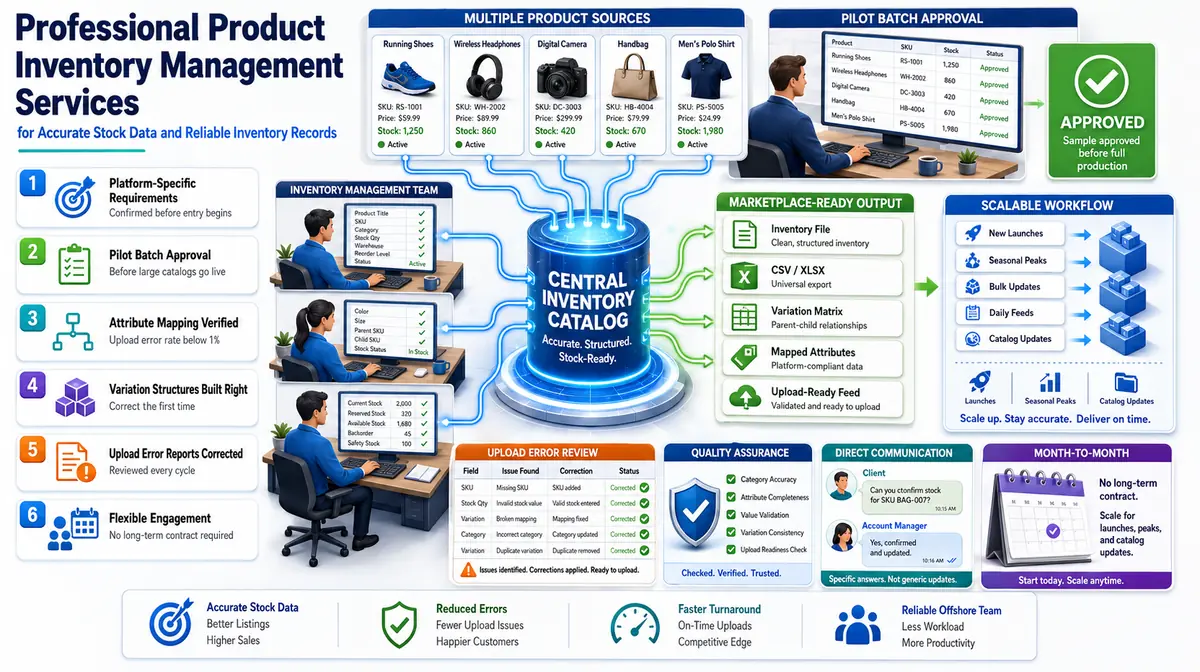

Stock records maintained around products, locations, events and approved availability rules

The client’s inventory system remains the authority; our role is controlled data preparation, entry and reconciliation.

01

SKU and location master maintenance

Product SKU, barcode, warehouse, bin, condition, unit of measure and channel identifiers are captured or updated from approved master sources. Duplicate or inactive keys are held before transaction data is applied.

02

Receipts, issues and stock adjustments

Authorised receipts, dispatches, consumption, write-offs and count adjustments are entered with quantity, date, reference and reason. Unsupported changes are not used merely to make a balance reconcile.

03

Transfers, returns and condition changes

Origin, destination, transfer status, returned quantity, inspection state and disposition are maintained without counting the same units at two locations. Pending and completed movements remain distinguishable.

04

Available, reserved and safety-stock fields

Approved rules are used to prepare on-hand, committed, reserved, unavailable and safety-stock values for the relevant system or channel. Allocation policy and sellable-quantity decisions remain with inventory owners.

05

Marketplace and store inventory updates

SKU-level stock files are prepared for approved eCommerce stores, marketplaces or distribution partners. Channel identifiers, update times, accepted records and failures are reconciled before another cycle is released.

06

Inventory reconciliation and exception review

Opening balance, authorised movements and closing balance are compared by SKU and location. Negative stock, missing references, duplicate events, unusual adjustments and source-system differences are reported for owner action.

Commerce Platform Compatibility

Product Inventory Management Services: Direct Integration and Software Compatibility

Outputs are prepared around the field structure, controlled values and import requirements of your destination environment. Files can be delivered for review, staging or authorised import without forcing your team to rebuild the completed work.

Supported destinations

Catalog and product files prepared for multichannel commerce

Files are mapped to the client’s approved template, naming rules, identifiers and system structure before full production begins.

  • ShopifyProducts, variants and collections
  • WooCommerceCatalog and attribute imports
  • AmazonSeller and marketplace templates
  • eBayListings and item specifics
  • Magento / Adobe CommerceCatalog and store-view fields
  • PIM / ERP SystemsClient-defined product schemas
Source continuity

References stay connected

Source IDs, filenames, record keys and approved relationships remain available for review and downstream traceability.

Import control

Fields are mapped before production

Mandatory fields, formats, controlled values, character limits and relationship keys are checked against the destination specification.

Pilot validation

Test the handoff with a representative batch

Rejected rows, unsupported values and mapping conflicts are returned with exact references so approved corrections can be incorporated before full-volume delivery.

Delivery formatsStructured for review, staging or import
  • CSV
  • XLSX
  • XML

Column order, encoding, date rules, multi-value handling and destination-specific requirements can follow the receiving system’s approved specification.

Compatibility means SDES prepares outputs to specifications supplied or approved by the client. Product names identify commonly used destination systems and do not imply endorsement, certification or partnership.

Process, Quality and Security

An inventory data workflow from controlled cut-off to reconciled closing balance

1. Define the Inventory States

Systems, locations, quantity types, units, cut-offs, channels, references and owners are documented.

2. Map Events and Authority

The setup review defines how receipts, issues, returns, transfers and adjustments affect each balance.

3. Pilot a Closed Period

Representative SKUs, multiple locations, pending movements and exceptions test the reconciliation rules.

4. Process Authorised Updates

The delivery team records events and preserves SKU, location, timestamp, reference and reason.

5. Reconcile Balances and Feeds

Opening stock, movements, closing stock and channel results are checked for completeness and duplication.

6. Release Reconciled Stock Updates and Balance Holds

Approved output files and issues requiring warehouse, planning or commercial decisions are separated.

📂 Source formats we accept
  • Product and location master files
  • ERP, WMS and store inventory exports
  • Receipt and dispatch records
  • Transfer, return and adjustment files
  • Reserved and safety-stock rules
  • Channel templates and processing reports
📤 Delivery formats
  • Updated SKU-location inventory file
  • Inventory transaction register
  • Transfer and return status dataset
  • Channel stock-update file
  • Inventory reconciliation report
  • Negative, duplicate and unresolved-event log

Quality checks cover SKU and barcode identity, location, unit of measure, quantity sign, inventory state, transaction date, cut-off, source reference, reason code, duplicate-event risk and arithmetic agreement between opening, movement and closing balances.

Inventory reconciliation does not prove that physical stock exists. Count differences, unexplained adjustments and conflicting system balances remain exceptions for warehouse or finance owners rather than being concealed through balancing entries.

The production team records authorised inventory data. An expert client owner approves physical counts, purchase and replenishment decisions, allocations, write-offs, safety-stock policy, channel buffers and final posted balances.

🔒 NDA Protected Before files are shared
🌐 GDPR Aware EU data handling
Defined Quality Target Confirmed by pilot
🛡️ Secure Transfer Encrypted file access
📋 Exception Log Every delivery
👥 Project Team Only Controlled access
Free accuracy test

Need your inventory records kept accurate without increasing internal headcount?

Share your inventory system details and a sample of your update documentation. We process a free pilot batch so you can verify accuracy and update rule compliance before committing to ongoing production.

✓ No credit card required✓ No contract required✓ 24–48 hour return
Get a Free Pilot Batch
Source sampleyour_sample_data.csv
Received
Verified deliveryverified_output.xlsx
Reviewed
▣ Encrypted transfer◉ Quality controlled
Why Outsource to SDES?

Why inventory data support must preserve the event behind every balance

Product Inventory Management Services workflow and quality review
  • SKU-location control
  • State separation
  • Cut-off discipline
  • Adjustment evidence
  • Channel reconciliation
  • Scalable update capacity

Operations teams outsource professional product inventory management support when recurring data maintenance consumes the time needed for forecasting, purchasing and fulfilment.

The documented workflow gives the delivery team precise entry and reconciliation rules while physical verification, replenishment, allocation, write-offs, safety stock and final balance approval remain with authorised owners.

Start Your Project →
Industries We Support

Inventory data support adapted to different stock movements and controls

Retail and eCommerce

Store, warehouse and channel stock updated by SKU and variant with reservations and availability kept distinct.

Manufacturing

Raw materials, components, work-in-progress references and finished goods maintained under approved movement rules.

Distribution and Logistics

Multi-location receipts, transfers, returns, damaged stock and customer allocations reconciled by event.

Medical and Laboratory Supply

Approved item, location, lot-related references and condition states maintained without overriding regulated controls.

Electronics and Equipment

Serialized or model-specific inventory references, returns and refurbishment conditions kept attached to exact products.

Furniture and Building Products

Bulky-item quantities, finish variants, packages and inter-warehouse movements recorded by location.

Case Studies

Relevant Project Experience

Multi-Warehouse Stock Reconciliation

Project Name
Multi-Warehouse Stock Reconciliation
Volume
184,000 SKUs across 17 distribution centres — completed in 6 weeks
Problem
Transfer files and warehouse receipts used different completion times, causing units to appear simultaneously at origin and destination.
Solution
A professional movement-state register linked dispatch, in-transit and received events to the same transfer reference before closing balances were prepared.
Outcome
The distributor gained a reconciled location view and a focused queue for transfers missing destination confirmation.
Title
Inventory Control Director
Industry
Consumer Goods Distribution
Country
Canada

Marketplace Availability Recovery

Project Name
Marketplace Availability Recovery
Volume
72,000 variants across six sales channels — completed in 7 weeks
Problem
Channel stock files used inconsistent SKU aliases and update schedules, leaving old availability live after warehouse balances changed.
Solution
The delivery team created an approved SKU-channel map and timestamped each submitted quantity. The solution reconciled accepted and failed updates while authorised owners retained buffer and allocation decisions.
Outcome
Operations could distinguish current channel stock from stale or rejected records without increasing overselling risk through guesses.
Title
Head of Omnichannel Operations
Industry
Fashion Retail
Country
Australia

Returns and Adjustment Control Desk

Project Name
Returns and Adjustment Control Desk
Volume
310,000 annual return and adjustment events — completed in 5 weeks
Problem
Returned units moved through inspection, refurbishment and write-off states, but spreadsheets often lacked a consistent reason or disposition.
Solution
structured review applied approved status and reason dictionaries, linked supporting references and isolated events that lacked authority.
Outcome
The manufacturer received cleaner inventory movements and an auditable exception queue for warehouse and finance approval.
Title
Supply Chain Data Manager
Industry
Consumer Electronics
Country
Germany
FAQs

Questions to resolve before inventory data production begins

Do you physically count or own our inventory balances?

No. We prepare, enter and reconcile authorised records. Physical verification and final inventory authority remain with the client’s warehouse and control teams.

Can you update stock across marketplaces and online stores?

Yes, using approved SKU mappings, quantities, templates and access. Accepted and failed records are reconciled after each update cycle.

What should we provide when we outsource product inventory management support?

Provide product and location masters, quantity definitions, source transactions, cut-off rules, reason codes, channel mappings, approval limits and named owners.

Which items are held for client review during Product Inventory Management Services?

For Product Inventory Management Services, anything that cannot be read confidently — conflicting identifiers, unsupported classifications, decisions outside the approved guide — is held apart from clean catalog and product records rather than guessed. Held items keep their source reference for the authorised reviewer.

📩 Get a Free Pilot Batch
💬