Outsource Data Mining to India: Expert Offshore Solutions Turning Data into Actionable Insights

Outsourcing Data Mining Services: Transforming Data Into Business Breakthroughs

Think about the last time you had to make a call that could shape your business. Maybe you paused and weighed your options, trusting your gut because that’s what’s worked before. Or maybe you stared at a spreadsheet, a dashboard, or even a mountain of reports, hoping the right answer would jump out at you. It’s not just the biggest companies with deep pockets that have access to data power these days—businesses of all shapes and sizes are sitting on a goldmine of information. Still, I hear it all the time: people feel buried under numbers, with no clear way to turn all those stats into something useful. If you’ve ever found yourself lost in the data jungle, you’re definitely not alone.

I talk to managers and leaders across all kinds of industries—people who are experts at running stores, caring for patients, steering supply chains, or dreaming up new products. They know their fields inside and out. But when it comes to pulling practical insights from their data, that’s where things get tricky. Let’s face it: making sense of piles of data isn’t easy. It’s a craft that takes patience, the right technology, and a level of know-how that’s tough (and costly) to build within your own team. That’s exactly why so many businesses are choosing Shri Data Entry Services to outsource their data mining. By teaming up with offshore specialists—especially those in data-driven places like India—you’re not just cutting costs. You’re getting a crew of people who truly “get it,” folks who’ve helped solve data problems for all kinds of businesses and know how to turn raw facts into real results.

The Underlying Challenge: Information Overload

Let’s be real—these days, it’s almost never a lack of data that trips people up. In fact, it’s usually the opposite. Most of us are swimming in charts, endless reports, and numbers that seem to multiply overnight, yet somehow, the answers stay just out of reach. Maybe you spent good money on some fancy dashboard or hired that new analyst everyone raved about, but now those tools are gathering dust, and you’re still not sure which numbers actually matter. Maybe you recognize that glazed look your staff gets after another afternoon wrangling spreadsheets instead of actually using the info for something meaningful. It’s enough to make anyone frustrated.

That’s why outsourcing data mining isn’t just about pinching pennies. It’s about finally putting those nagging questions to rest—the ones you can’t shake, even after you close your laptop for the night. Like, “Are we actually holding onto our best customers, or just hoping they’ll stick around?” Or, “Why does it feel like money is leaking out somewhere, but we can’t put our finger on it?” Or even, “What’s waiting for us around the corner, and are we ready?” That’s where the right offshore data mining partner makes all the difference. Suddenly, the fog lifts, and you’re not just staring at chaos—you’re seeing the road ahead, clear as day.

Why Businesses Outsource Data Mining Services

Let’s face it: the world is moving too fast for guesswork. Decisions are best made on facts, not hunches. The organizations thriving today are the ones who can quickly spot patterns and adapt to change. That’s the edge that professional data mining outsourcing delivers.

What Sets Outsourced Data Mining Apart?
Outsourcing means you’re teaming up with people who spend their days—sometimes even their nights—diving deep into data. These folks have sifted through more spreadsheets than most of us can imagine, and they’ve worked with data sets so huge they make your head spin. What really sets them apart is their knack for spotting patterns and untangling the messy bits, finding the real story hidden beneath all the numbers.

When you work with offshore data mining specialists, especially those with a strong track record in places like India, you’re getting a partner who’s already tackled challenges just like yours—whether you’re trying to fight fraud, spot what your customers want next, or just get your records in order. There’s a certain confidence that comes from experience, and these teams bring that “we’ve seen it all before” attitude to the table. On top of that, the cost savings are real. Instead of hiring a whole in-house team, you get all that knowledge and technical muscle for a fraction of the investment—which, let’s be honest, is music to any CFO’s ears.

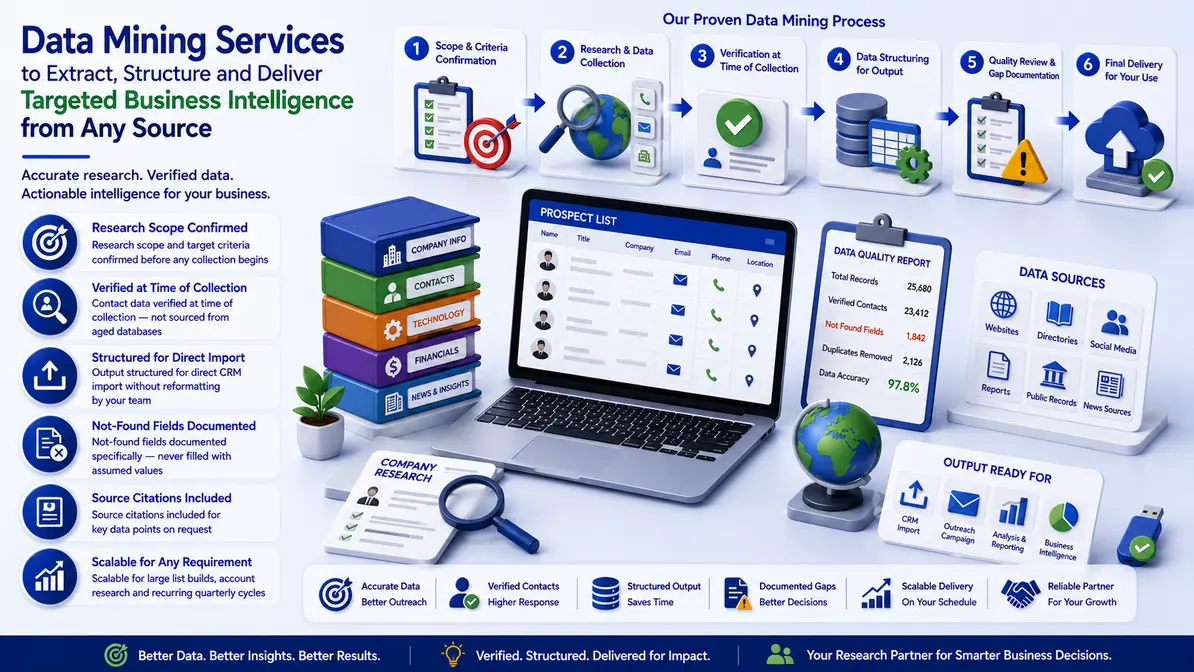
Our Data Mining Services: Turning Raw Data Into Real Results

1. Data Collection and Aggregation
Let’s face it—trying to gather all your business’s data can feel like a scavenger hunt where half the clues are missing. One day you’re tracking down last month’s sales numbers buried in a colleague’s email, the next you’re staring at a stack of handwritten notes left over from a trade show. You’d be surprised how often we find the most important piece of data hiding in the oddest spot—like a sticky note on someone’s monitor or a spreadsheet saved under “finalversion3reallyfinal.xlsx.” We don’t just rely on fancy software; we get curious, double-check things, even call team members to ask, “Hey, do you have the latest version of this file?” Our approach isn’t just technical—it’s personal. By the end, you’ll have everything in one place and won’t have to play detective with your own business anymore.

2. Data Cleaning and Preprocessing
If you’ve ever seen a report that claims someone made a purchase in 1901, or noticed three different birthdates for the same customer, you know how quickly bad data can send you down the wrong road. We, At Shri Data Entry Services, treat data cleaning with the same attention you’d give to balancing your checkbook—carefully, and with more than a little skepticism. Sure, we use some smart tools to catch the obvious stuff, but nothing replaces a human eye. We’ll spot those weird outliers, call out numbers that don’t pass the sniff test, and make sure things actually line up with common sense. If something genuinely puzzles us, we’ll ask for your input rather than guess. You end up with data that’s not just technically accurate, but actually trustworthy.

3. Pattern Detection and Predictive Modeling
This is where things get a little exciting—honestly, it’s the part we geek out over. There’s something satisfying about spotting a trend before anyone else. Maybe we notice that sales always dip right before a long weekend, or we catch that customers from a certain city buy more of a specific product. We don’t just run the numbers and hand you a dense report full of jargon. We like to pull you into the process, walk you through what we’re seeing, and talk through what those patterns could mean for your next steps. Sometimes we’ll use a graph or two—other times, it’s just a good old-fashioned conversation. Either way, it’s about making the numbers work for you, not the other way around.

4. Custom Reporting and Visualization
Have you ever opened a report and immediately closed it because it looked like it was written in another language? We get it. That’s why we, At Shri Data Entry Services, build reports that actually make sense to the people who need to use them. We use plenty of color, clear headings, and real-world examples so you don’t have to squint at the screen or guess what’s important. Need to show your business partner how last quarter went, or prove to yourself which marketing campaign really worked? We’ll lay it out clearly so you can see the story at a glance. And if you ever want to see things displayed differently, just let us know—we’re happy to tweak things until they’re just right.

5. Integration and Automation
Nobody wants to bounce between a dozen different programs just to get through the workday. We take the time to understand how your business actually runs, then slide our data solutions right into the systems you already use. Maybe you want sales reports to pop up in your inbox every morning, or need inventory updates to sync with your ordering software. We can make that happen, and we’ll automate the boring, repetitive stuff so your team gets more time for the work only humans can do. If something ever doesn’t fit quite right, we’ll adjust it—no one-size-fits-all here.

6. Security and Compliance Management
We know how hard you’ve worked to build trust—with your customers, employees, and partners. Handing over your business data is a big deal, and we don’t take that lightly. Our team treats security like locking up the family safe: we use strong locks, keep a close eye on who has the keys, and always follow the rules. If you ever have a question about how your data is being protected or need to meet some new regulation, we’ll walk you through it in plain English. You shouldn’t have to lose sleep over whether your data is safe—you’ve got enough on your plate.

Industries We Serve: Real Problems, Real Solutions

Retail & E-Commerce
I’ll never forget chatting with Maria, who runs a couple of busy shops in Brooklyn. She told me, “Every year it feels like I’m rolling the dice when I place orders—sometimes we nail it, sometimes we’re stuck with boxes of unsold stuff.” We sat at her counter and pulled up sales from the past few seasons, but we didn’t stop there. We checked the weather (that weird April heatwave was a game-changer), scrolled through neighborhood Facebook groups, and even talked to her staff about what regulars were asking for. It wasn’t long before Maria stopped guessing and started noticing patterns—“Hey, look, people really do shop more before those little league tournaments in the park!” Her team started stocking up on the right things, and the relief on Maria’s face when her back room wasn’t overflowing? That’s the kind of win you feel in your bones.

Financial Services
A few months back, I was in Zurich with Paul, a credit union manager who’s seen it all. “You know,” he said, “it’s not the big fraud we worry about—it’s the sneaky stuff, the little blips that slip through.” We pulled up his team’s flag reports and started digging. Along the way, Paul pointed out that one member who always came in at lunchtime—turned out, his pattern was the missing link in catching a scam before it cost them big. We started setting alerts not just for odd amounts, but for odd timing. Weeks later, Paul called just to say, “We caught one early this time. No panic, just a quiet save.” That little bit of calm? Worth its weight in gold.

Healthcare
In Dallas, there’s a nurse named Evelyn who runs the ER shift calendar. She once told me, “Flu season is just a guess and a prayer.” Together, we looked at admissions over the years, but the real breakthrough came when we noticed a spike after local schools reported absences. “That’s when we should prep extra beds,” she said, and suddenly the madness at the nurses’ station smoothed out. The next winter, Evelyn texted me a photo—her team wasn’t swamped, patients were getting seen faster, and she finally got to take her lunch break. There’s no data point for peace of mind, but you can see it in the smiles.

Manufacturing
There’s a guy in Detroit named Larry, who’s got grease on his hands and a sixth sense for when a machine’s about to act up. But even Larry admits, “Sometimes I get blindsided.” We set up a system to watch the machines’ little quirks—tiny changes in vibration, odd noises that only show up in the logs. The first time we predicted a breakdown before it happened, Larry just shook his head and laughed: “Well, I’ll be damned, that actually worked.” Now, his crew spends more time fine-tuning than firefighting, and the plant floor feels less like a ticking time bomb.

Telecommunications
Over in Philadelphia, I met Jasmine, who leads a team at a telecom call center. She once told me, “Some days, it feels like we’re just apologizing on repeat.” We started going through call logs together, and after a while, the same names kept popping up—folks who called three times in one week, always about dropped calls. Jasmine’s team began reaching out before complaints piled up, offering quick fixes and sometimes just a listening ear. “The weirdest thing?” Jasmine said a month later. “We’re getting thank you cards now.” Sometimes it’s not about technology—it’s about making people feel heard.

Real Estate
In Miami, there’s an agent named Felipe who swears by his gut but likes a little backup. “I had a hunch about this old neighborhood,” he confided one morning, “but everyone thought I was dreaming.” We looked at home sales, checked city council minutes for new parks, and listened to locals at the coffee shop. The data matched his hunch, so Felipe jumped in—and within six months, prices spiked. When he showed me the thank you notes from first-time buyers, I knew it wasn’t just a win for his business. It was a win for his whole community.

Logistics & Transportation
Marta in Hamburg runs a fleet of delivery vans. Before the holidays, her whiteboard was a mess of routes, sticky notes, and “fingers crossed” estimates. “I just want my drivers home for dinner,” she told me. We tracked shipments, mapped traffic trends, and even called drivers for their shortcuts. That season, not only were packages delivered on time, but Marta’s staff got home before dark. The team threw a party in the breakroom, and Marta finally took a weekend off.

Education
There’s a dean at a university in Boston—Dr. Lee—who never wants to lose a student for lack of support. She once said, “It’s not the big crises you see coming, it’s the quiet ones.” Together, we pored over attendance, grades, even club rosters. Dr. Lee’s team reached out to students who stopped showing up, sometimes just to ask, “Hey, are you okay?” The result? More cap-and-gown selfies at graduation, and a few thank-you notes that made all the late nights worth it.

Hospitality
Vienna’s Hotel Sommer is run by a manager named Lukas, who goes out of his way to remember frequent guests’ breakfast orders. He told me, “Big conventions used to keep me up at night—would we have enough staff, enough towels, enough patience?” After we reviewed booking patterns and city events, Lukas started hiring extra hands just in time. That year, guests raved about the service, and Lukas finally got to enjoy a cup of coffee at the breakfast bar without being interrupted. Sometimes, it’s the small changes that make the biggest impression.

Real-World Case Studies

1. Retail Inventory Revamp – Ethan R., Seattle, WA
Ethan’s story is one I hear a lot. He runs a handful of stores around Seattle, and every week felt like a scramble. Some days, he’d walk into a shop and see racks groaning with sweaters no one seemed to want, while another location would call him to say they’d run out of bestsellers—again. “It’s like playing whack-a-mole,” he joked one afternoon over coffee. After teaming up with our data mining crew, Ethan finally saw the whole picture. We sat down together, mapped out what was actually selling, and spotted overlooked patterns—like how rainier weeks drove up boot sales. A few months in, he told me his stockroom was finally under control, and he could actually enjoy the holidays instead of putting out fires. “I’m not just guessing anymore,” he said, with a grin I hadn’t seen in a while.

2. Financial Fraud Detection – Camille H., Geneva, Switzerland
Camille’s office in Geneva is always a whirlwind—phones ringing, people chatting, papers everywhere. But when a string of fraud cases hit, you could see the stress in everyone’s eyes. On our first call, Camille sighed and said, “It’s the sneaky fraud that keeps me up at night.” We rolled up our sleeves together, digging through transaction details and odd patterns that just didn’t sit right. After a few late evenings, our new model started catching the weird stuff early, and Camille called me, sounding genuinely relieved: “We stopped one before it became a disaster.” Her team started coming in with more confidence, not just bracing for the worst. For once, it felt like they were in control—and that feeling made all the difference.

3. Healthcare Resource Optimization – Daniel S., Dallas, TX
Daniel’s job at the Dallas hospital is a juggling act: enough staff, enough beds, and never quite enough hours in the day. He once told me, “There’s nothing worse than seeing patients waiting because we got caught off guard.” We rolled up our sleeves with his team and started piecing together patterns from years of admissions and even local event calendars. Suddenly, it became clear when surges were coming—after big sports games, during flu season spikes, or just before the holidays. The next time things got busy, Daniel’s team was ready. The waiting room emptied out faster, and a few nurses even thanked him for making their shifts less chaotic. “For the first time in years,” Daniel said, “we felt ahead of the curve.”

4. Manufacturing Efficiency Boost – Lucas T., Antwerp, Belgium
Lucas is the kind of plant manager who knows every bolt and belt in his Antwerp factory. But even he got blindsided by sudden breakdowns. “It always seems to happen at the worst time,” he sighed during a walk through the shop floor. We pulled up years of maintenance logs and machine sensor data, looking for the “tells” only a seasoned hand like Lucas would spot. Once the early warning signs were clear, Lucas started scheduling repairs before chaos hit. Weeks later, he called to say he’d finally had a Friday without a single emergency. “Now I can actually focus on making things better, not just keeping things running,” he said, sounding more relaxed than ever.

5. University Retention Program – Olivia G., Boston, MA
Olivia’s office is filled with sticky notes and student photos—she knows her campus community inside and out. “It hurts,” she once told me, “when a good student disappears and you realize you missed the signs.” We worked with her to pull together grades, attendance, and even club involvement, layering in little things like late-night library visits or missed meetings. Patterns emerged, and suddenly, Olivia’s team could gently reach out before a student vanished for good. She remembers the first thank-you email from a sophomore who turned things around after a rough patch. By the end of the year, more students were crossing that graduation stage, waving at Olivia in the crowd. “That’s what makes all the effort worth it,” she said, holding back happy tears.

Why Businesses Trust Us: Client Reviews on Outsourcing Data Mining

1. Jack M., Philadelphia, PA:
“I’ll admit, I didn’t expect data mining to make such a difference. But after a few months, we stopped losing so many customers—calls even got friendlier. It feels good to finally know what’s actually going on.”

2. Sarah P., Glasgow, UK:
“I used to guess what my shoppers wanted—now I just know. Our regulars have actually started asking how we always get it right. It’s made running the shop a whole lot more fun.”

3. Hugo L., Brussels, Belgium:
“Staff used to groan when the weekly schedule came out, it was always off. Now, the whole team says things just ‘work’ and I can breathe easier too. Patients even notice the smoother flow.”

4. Emily D., Miami, FL:
“I’ve been in real estate long enough to know timing is everything. The reports we get now help me spot trends before they hit—my clients see the results, and they tell their friends.”

5. Sophie V., Vienna, Austria:
“Some weeks our hotel was packed, others were a ghost town. Now I can see the ups and downs coming and plan ahead. We get fewer complaints, more compliments, and I finally feel in control.”

Frequently Asked Questions

Q1: Can I use outsourced data mining even if my business isn’t huge?
Oh, for sure. Some of the biggest wins I’ve seen have been with small businesses—sometimes just a handful of people. When you’re running lean, even one small insight, like figuring out your busiest time of day or why a certain product suddenly took off, can pay off fast.

Q2: What makes offshore data mining, especially from India, so reliable?
It’s really about the people—these are folks who’ve seen just about every data puzzle you can imagine. I’ve worked with teams who could spot a weird trend in a spreadsheet faster than I could find my own coffee mug in the morning. Plus, they know how to explain things without drowning you in tech jargon, which is a relief.

Q3: How long does it take to see results from data mining?
You’d be surprised. Sometimes, you’ll get your first “aha!” moment within the first week or two—like noticing a pattern nobody guessed was there. For bigger projects, it might take a bit longer, but either way, you don’t have to wait months to see something useful.

Q4: Is my sensitive business data safe with an outsourcing provider?
Honestly, I get the worry—handing over your data can feel a bit like giving someone your house keys. But the good teams take privacy seriously: locked-down systems, strict rules about who sees what, and they’re always willing to show you how it all works. If you ever want to double check, just ask. They’ll walk you through every step.

Q5: What if I need insights specific to my industry?
You’re not alone—every business has its quirks. The best part about outsourcing is that these teams don’t just hand you generic reports. They actually sit down, ask a bunch of questions, and dig into what makes your world tick. Whether you’re selling surfboards, running a medical clinic, or managing deliveries across town, they’ll shape the data work around your real-life needs, not just some cookie-cutter template. If something doesn’t make sense for your industry, they’ll tweak it until it does.

Ready to Turn Your Data Into Results?

You don’t need to have it all figured out before you reach out—that’s what Shri Data Entry Services is here for. Imagine feeling prepared for your next big decision, not just crossing your fingers and hoping for the best. We’ll sit down with you, listen to what’s keeping you up at night, and map out a plan that actually fits your business. From the first messy spreadsheet to the moment you start seeing real results, we’ll be by your side. Even if you just want to bounce around a few ideas or see what’s possible, let’s have a conversation. Your data has a story to tell; let’s unlock it together and put it to work for you.

Find The Best Solution For your Business